CISA’s Gunra advisory: what a PE operator should ask
A joint CISA/FBI StopRansomware note on Gunra is a control-freshness question, not a loss number. Here is what to ask one portco this week — and what the advisory does not prove.
On 10 August 2026, CISA, the FBI, and partner agencies published joint Cybersecurity Advisory AA26-222A, #StopRansomware: Gunra Ransomware. A CISA press release the same week restated the public facts and corrected a CVE link. This note stays inside those two pages. It does not invent victim counts, a dollar band, or a claim that any portfolio company was hit.
What the agencies actually published
Gunra is described as ransomware-as-a-service. The advisory says the variant appeared in 2025 and expanded into RaaS operations in 2026. The model is double extortion: encrypt data and threaten to publish stolen files if a ransom is not paid. The press release adds that negotiations run through a Tor portal, with a five-to-seven-day payment threat.
Initial access, as the authoring agencies wrote it, is not a mystery exploit. The FBI observed exploitation of two Fortinet authentication-bypass CVEs on internet-facing devices: CVE-2024-55591 and CVE-2025-24472. The press release notes that an earlier link pointed at the wrong CVE (CVE-2024-5559) and should have pointed at CVE-2024-55591. If a portco ticket still cites the wrong identifier, the ticket is already stale.
Named sectors in the press release include healthcare and public health, financial services, government services and facilities, and professional and nonprofit services. That is a targeting description. It is not a census of your fund.
Published mitigations are the ones every operating partner has already heard and still has to verify: patch known exploited internet-facing systems, keep backups immutable and offline-tested, and segment so one compromised device is not a path across the estate.
The hold-period cut
Do not forward the advisory as a board scare. Do send four questions that an honest CISO can answer with evidence, not adjectives.
Which internet-facing Fortinet or VPN appliances are in this company, and which versions? Request a dated inventory and confirm its scope. An incomplete inventory is an evidence gap; it does not rule out a vulnerable appliance or an incident.
Are CVE-2024-55591 and CVE-2025-24472 closed, waived, or unknown? Unknown is the expensive answer. A waiver needs an owner, a compensating control, and a date.
Where do backups actually live, and when were they last restored? The advisory’s backup line is only useful if someone can show a tested restore, not a checkbox.
If this path opened, which business service sits on the far side of the segment? That starts a scoped loss scenario. The advisory supplies context; company evidence, frequency and severity assumptions are still needed before modeling annual loss.
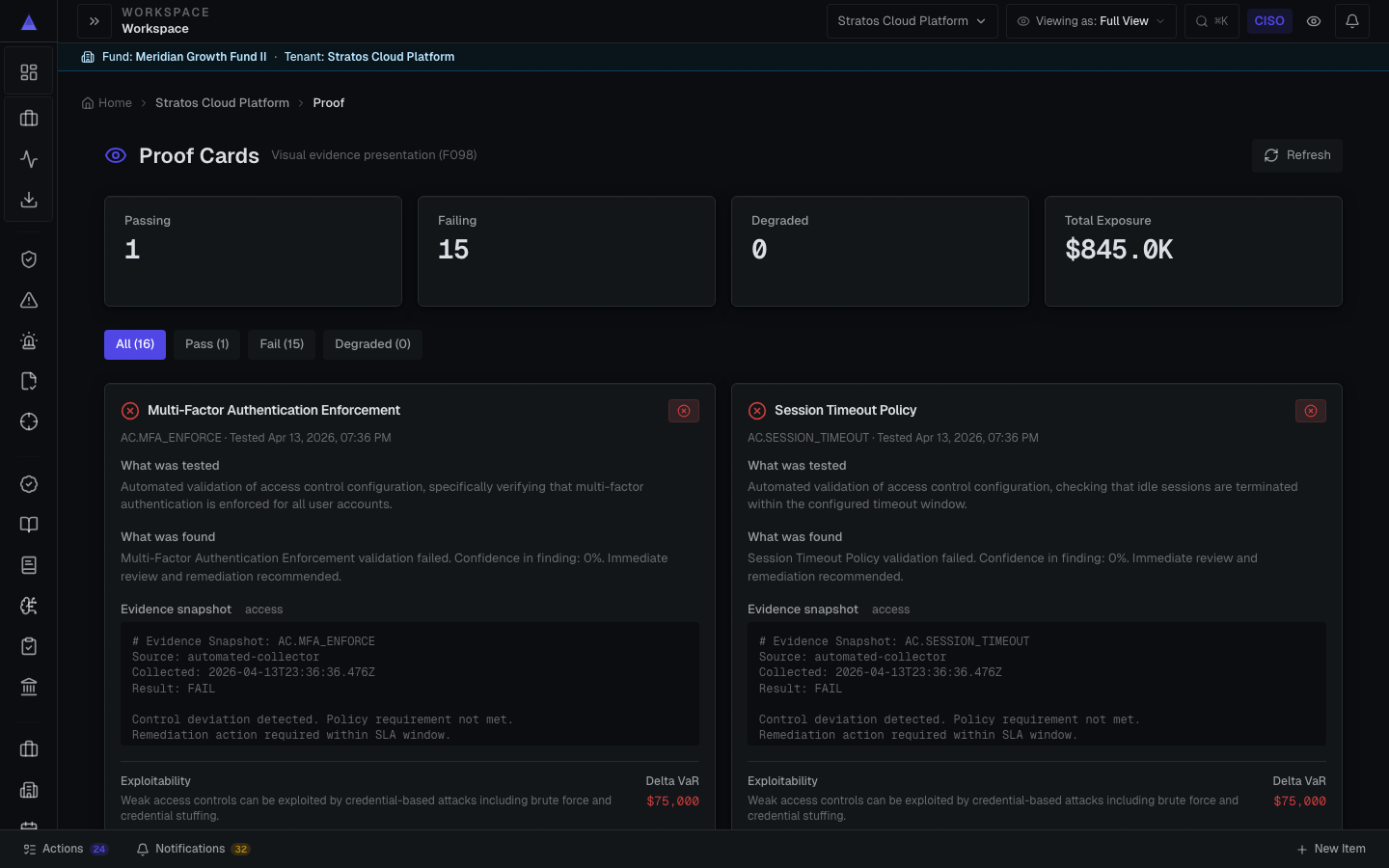
Valty connects a company’s evidence and cost assumptions to a funding comparison. The public sample reports modeled mean, median and P95 annual gross loss from a fictional scenario; it does not adjust EBITDA or model insurance recovery. A free platform demo shows illustrative data. Company evidence, supported workflows and terms are agreed separately before evaluation access. A joint advisory is a source, not a company loss estimate.
What this does not prove
It does not prove a dollar outcome for any portfolio company. A public advisory is not a tenant evidence file.
It does not certify that a portco is safe, unsafe, CMMC-ready, or insurable. CISA and the FBI are not underwriting your renewal.
It does not replace counsel on disclosure, notification, or materiality. If an incident is already in progress, that call belongs to the company and its advisors.
It does not let Valty claim a first-party detection, a victim count, or that we observed Gunra in a design-partner environment.
Inspect the fictional sample decision memo to see its assumptions and limitations, or request a platform demo to explore the supported workflow with illustrative data.
Sources
- CISA, #StopRansomware: Gunra Ransomware (AA26-222A) — 10 August 2026
- CISA, FBI and Partners Warn Organizations of Gunra Ransomware Actors — press release, 10 August 2026, revised 11 August 2026
- CVE-2024-55591
- CVE-2025-24472
Limitations
This brief summarizes the public CISA pages only. It does not reproduce the full IOC list or detection appendix, and it does not treat a press quote as a loss model. If a portco needs the technical package, open AA26-222A. If they need a priced range, that still requires their evidence.