01
Quantify loss
Frame one company, one loss objective, and the evidence and assumptions behind the modeled annual-loss range.
Platform
Bring a failed control and its source evidence. Valty compares feasible actions against one budget, shows the modeled financial tradeoff, names the owner, and packages the chosen path as a board pack, IC brief, or audit artifact.
Source evidence→Compare actions→Fund one path→Export proof
Company context and source evidence support every stage. The supported evaluation scope determines which sources, actions, and reporting paths are available.
01
Frame one company, one loss objective, and the evidence and assumptions behind the modeled annual-loss range.
02
Compare supported actions against the company budget and chosen loss objective, with missing inputs kept visible.
03
Name the owner and required approval before supported work proceeds; execution remains bounded by connected tools and permissions.
04
Return at the scheduled review with current evidence. State whether movement is modeled or observed and keep unsupported claims blocked.
Bring the evidence your teams already maintain. Agree source coverage and the decision to model before a scoped evaluation.
Scanners, EDR, SIEM, GRC, cloud posture, identity, and financial systems stay the authoritative record. Valty normalizes their evidence into financial language and proof artifacts.
Review source coverage, confidence, and evidence dates alongside modeled figures. Missing or stale evidence belongs in the review, with a named owner.
The supported reporting workflow pairs modeled outcomes with assumptions, sources, and unresolved evidence gaps for finance and security reviewers.
Financial estimates are decision-support ranges with method, confidence, and limitation next to the claim, built to be challenged by CFOs and operating partners before approval.
Explore individual Valty application captures with illustrative data. Each shows a product surface; together they are not a reconciled transaction or a customer result.
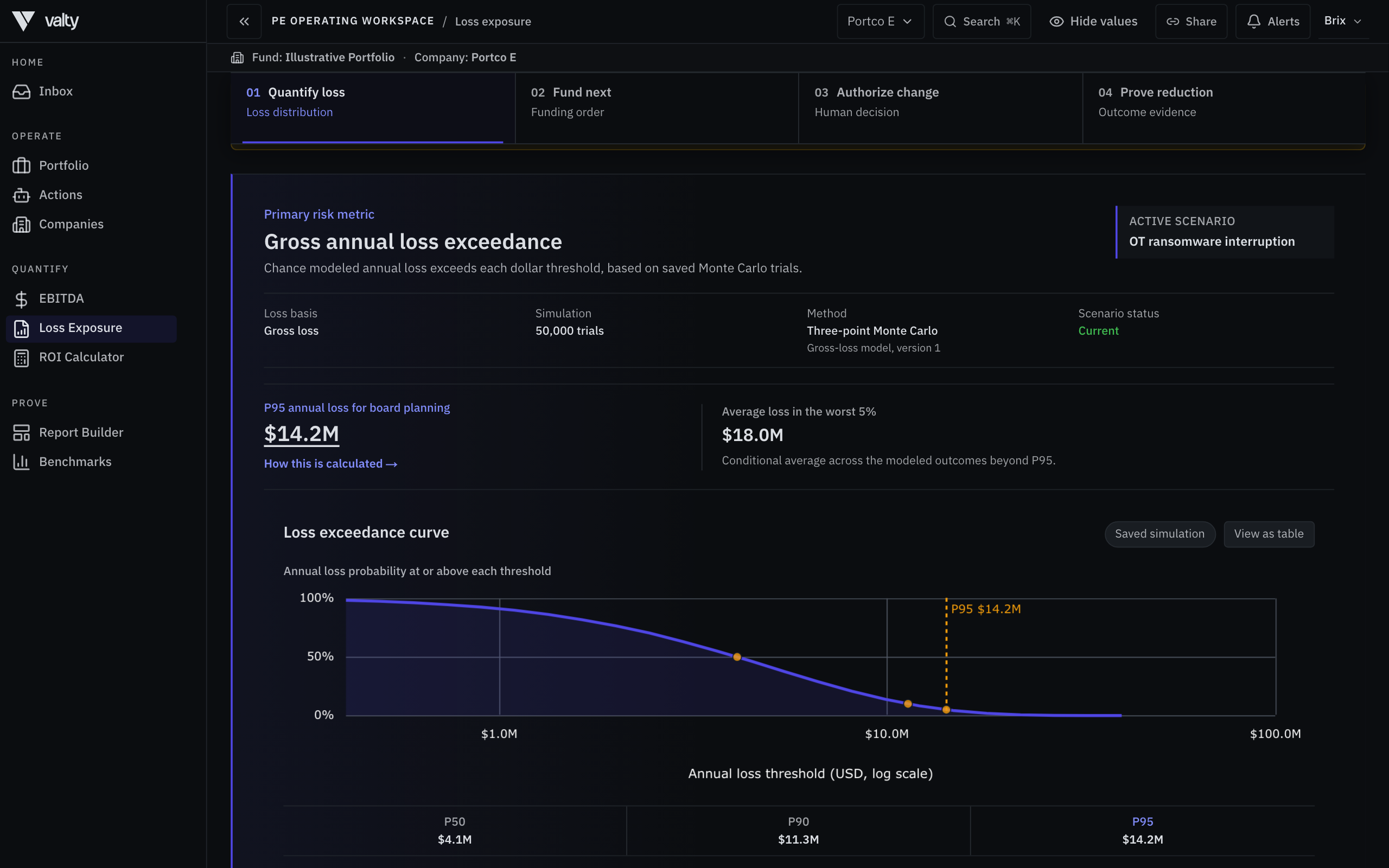
Inspect modeled annual loss and the assumptions behind it. The P95 marks a loss threshold exceeded in 5% of simulated years; it is not a forecast or a maximum possible loss.
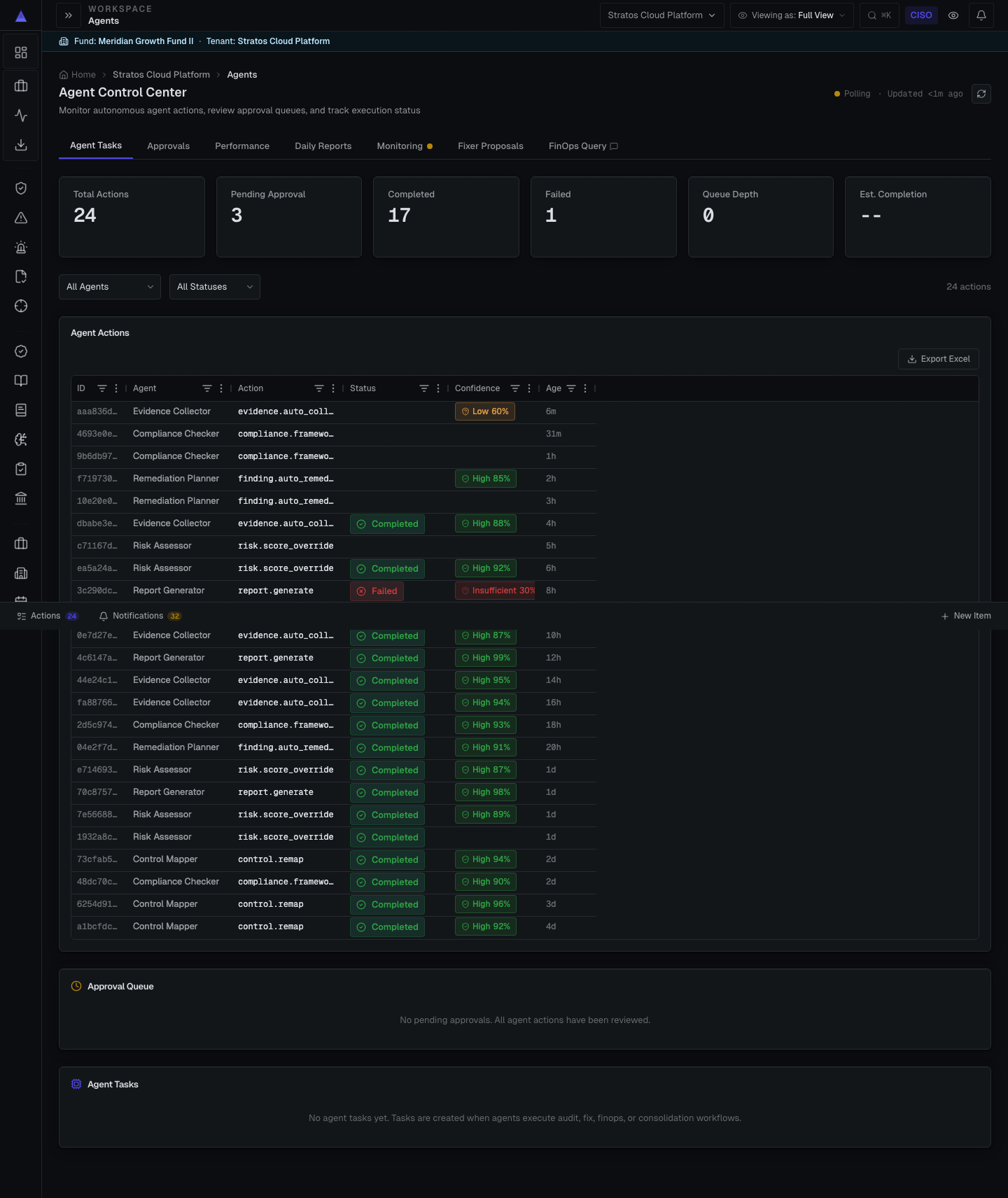
Turn supported control findings into proposed work with an owner and approval requirements. Review authorization, execution status, and failures in the same workspace. Supported actions depend on your connected tools and permissions.
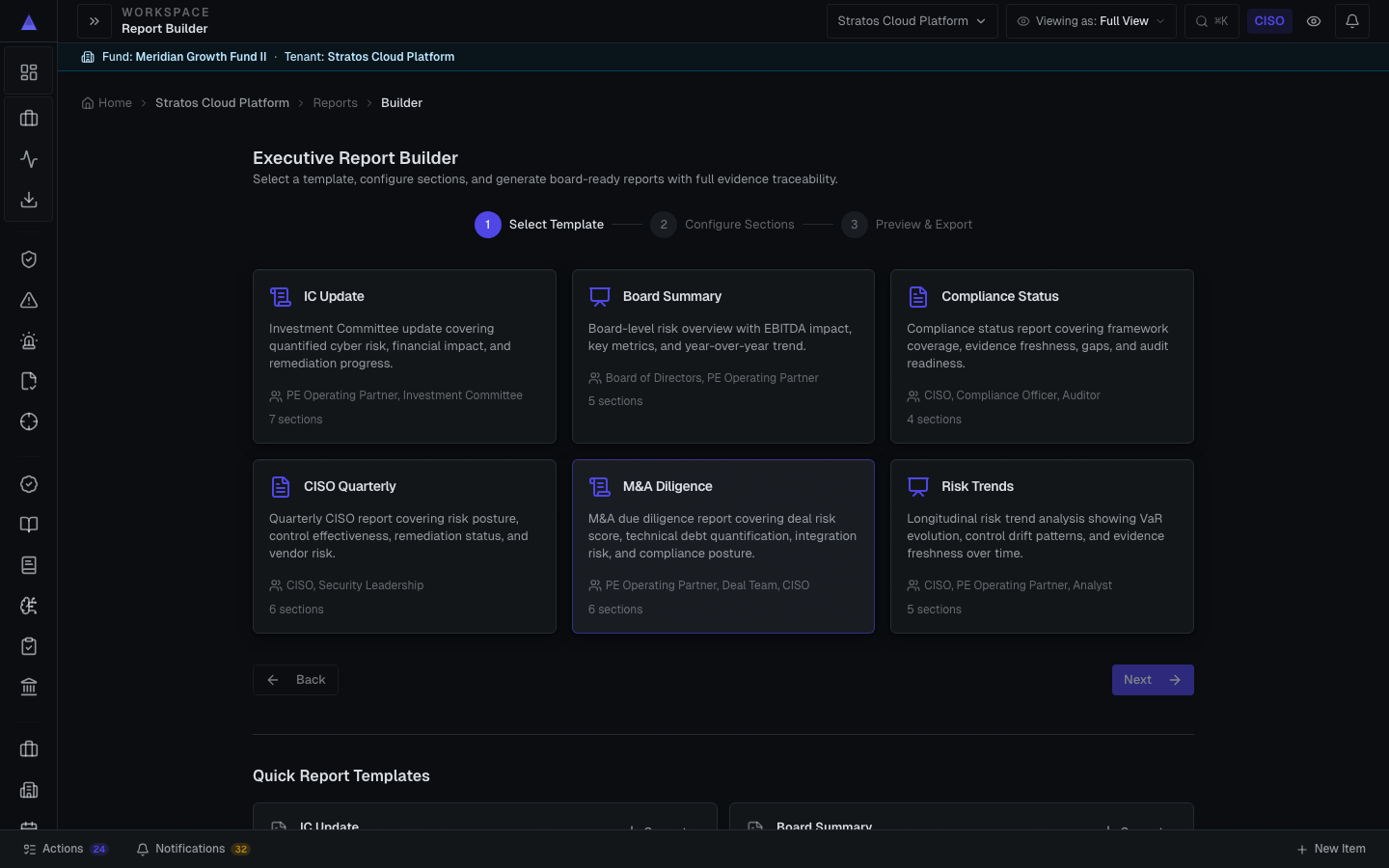
Select an IC Update, Board Summary, or another format. This screen shows template selection before a report is produced.
For a separate worked funding example, read the sample decision memo
Fictional sample · 2026-09-05
P95 annual loss · no insurance recovery modeled
No optional action: the sponsor-required tabletop is included, with no modeled loss reduction. Synthetic assumptions, not a customer forecast.
About 5% of modeled years exceed P95. It is an outcome percentile, not a worst case or a confidence interval. These synthetic inputs have not been externally calibrated.
The sample memo models one fictional company using a pinned product Monte Carlo engine. It compares competing actions against one budget and makes the objective explicit: the action with the lowest modeled mean loss differs from the one with the lowest P95. These synthetic assumptions are separate from every actual application capture on this page.
Reproducing this example establishes its arithmetic, not calibration to a real company. It models gross annual loss without insurance recovery and makes no EBITDA adjustment, valuation, or customer-outcome claim.
Inspect sources, input assumptions, and unresolved evidence before acting on a modeled number. The sample shows how those distinctions affect a funding recommendation.
Valty reads the scanners, cloud posture, identity, EDR, and GRC exports you agree to share, and maps that evidence onto the framework catalogs in scope for the engagement, so coverage is measured, not assumed. Mapping is not certification. No rip-and-replace to get started.
Findings, control catalogs, SBOMs, and supplier assessments load as evidence objects: CSV, SARIF, and structured exports, with owner and freshness attached.
Scanners, cloud posture, identity, EDR, and GRC systems connect as evidence sources scoped in the design-partner engagement, so coverage is measured, not assumed.
New connectors join the same evidence contract: every signal carries source, confidence, and freshness, so the financial model stays honest as coverage grows.
Explore the platform in a free 30-minute demo. If there is a fit, agree one initial company and decision, supported users and evidence, onboarding, and the next review before evaluation access. Recurring reviews and additional companies follow only when the supported scope is agreed.
See the supported platform workflow in a free demo, then agree company scope, users, evidence handling, capabilities, onboarding, and commercial terms before evaluation access.
Request a platform demoConnect findings, controls, owners, and proof artifacts.
Map your evidence sourcesInspect assumptions, confidence, and source citations around dollar estimates.
Review the financial-risk modelFactual readiness, component provenance, and crosswalk for review.
Discuss readiness package