Cyber Insurance Renewal: Build a Reviewable Evidence File
Prepare a renewal evidence register with source, scope, freshness, exceptions and ownership. Keep modeled loss and policy review separate from acceptance or pricing.
A useful cyber-insurance renewal file connects each answer to current evidence, makes exceptions visible and gives the broker or underwriter a clear way to ask follow-up questions. It can support review without predicting acceptance, coverage or price.
Start with the ungated renewal evidence worksheet. Record the policy/application scope, source date, owner, unresolved gaps and the reviewer who will check the answers before submission. The worksheet supports preparation; it does not replace the insurer's required forms or advice on policy wording.
Start with the actual question and scope
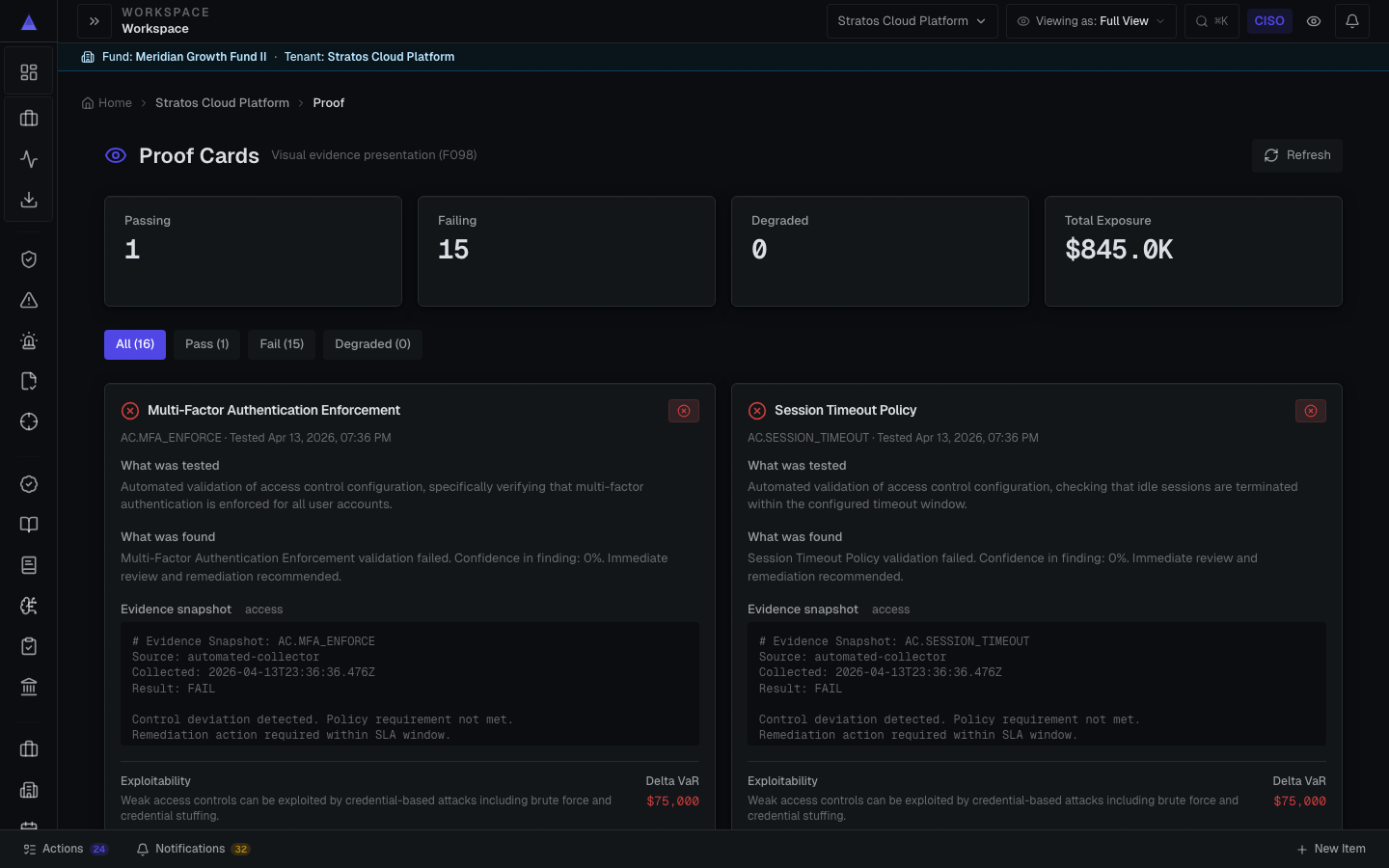
An MFA question may concern remote access, privileged identities, all users or a particular service. Preserve the requested wording and identify the population covered by the evidence. Registration is not necessarily enforcement. Excluded identities, report-only policies and unavailable sources need to remain visible.
Do the same for endpoint protection and recovery. Name the known inventory denominator and when reporting was last observed. A coverage percentage based on incomplete inventory is not proof of full coverage. For backups, distinguish protection settings and recovery-point age from an actual restore test with a scoped target, observed result and recovery criteria.
Ask the broker or underwriter what evidence is required and how exceptions should be presented. Do not replace a qualified answer with an unconditional “yes” to make a questionnaire look complete.
Build a reviewable evidence register
For each material assertion, record:
- The business service, assets and identities in scope.
- The source system, observation time and collection method.
- What the check actually established and what it did not test.
- Exceptions, missing permissions, unavailable data and freshness limits.
- The accountable owner, reviewer and next evidence date.
The public integration guide names bounded evidence and work-routing examples. Collection coverage, permissions and cadence are agreed for the evaluated environment. A provider connection or exported document is not by itself evidence of an effective control.
Valty uses collection labels to distinguish direct source evidence, assisted collection and owner attestation. Those labels are not a universal insurer reliance hierarchy. The recipient evaluates the source, scope, method and relevance of each record.
Keep financial analysis separate from policy interpretation
A loss model can help management compare funding options. Its scenario, time horizon, assumptions and metrics need to be explicit. The public methodology describes a separate fictional 50,000-trial example with mean, median and P95 annual gross loss. It assumes no insurance recovery and is not a model of the reader's company or policy.
A policy comparison requires its own verified inputs: limits, retentions, relevant terms, exclusions and the loss scenarios being considered. Missing or ambiguous policy language should remain unresolved for the appropriate reviewer. A model does not decide whether a particular claim will be covered or paid.
Valty is not an insurer or broker. A platform evaluation should demonstrate the exact evidence and policy-review output proposed, including its limitations and required approvals. The public sample does not establish insurer acceptance or production availability for every insurance workflow.
Fund work for an explicit reason
An approaching renewal can create deadlines, but it does not make every control change a known premium saving. Separate three reasons for work: an actual documented requirement, an internal risk objective and an expected commercial outcome that still needs confirmation.
For a funding comparison, use the full action cost, implementation dependencies and a consistent loss objective. Ask the broker whether a proposed improvement is relevant to the current submission, and retain the answer as context rather than treating it as a guaranteed quote change.
The worked decision guide shows why mean annual loss and P95 can favor different investments under the same budget. Neither a lower model output nor ten closed findings proves that insurance terms will improve.
Keep the history as the environment changes
Preserve the evidence used for each submitted answer, its date and scope, and the review that authorized it. Later collection should create a new observation rather than silently changing the basis of an earlier statement.
When an identity exception appears, a collector fails or a control changes, record what is known and who needs to review it. Source gaps should not remain labeled current. Any obligations to notify a broker or insurer depend on the applicable agreement and professional review; a monitoring tool does not resolve that question.
A useful record supports questions about what was observed at a particular time. It cannot establish every unobserved state between checks or eliminate a coverage dispute.
Review before handoff
The CISO or control owner confirms technical scope and evidence. Finance supplies the relevant business and cost assumptions. The broker, counsel or other authorized reviewer handles the applicable submission and policy questions.
Keep a clear list of unresolved items and owners alongside the package. Confirm recipient access and data handling before distributing company evidence. Better organization can make the review easier; the recipient still controls acceptance and any commercial decision.
Inspect the fictional sample decision memo, or request a platform demo to explore the supported workflow with illustrative data. Company scope, evidence handling, access, onboarding and commercial terms are agreed separately before evaluation.